What Is Knowledge Management?
lightbulb Executive Summary
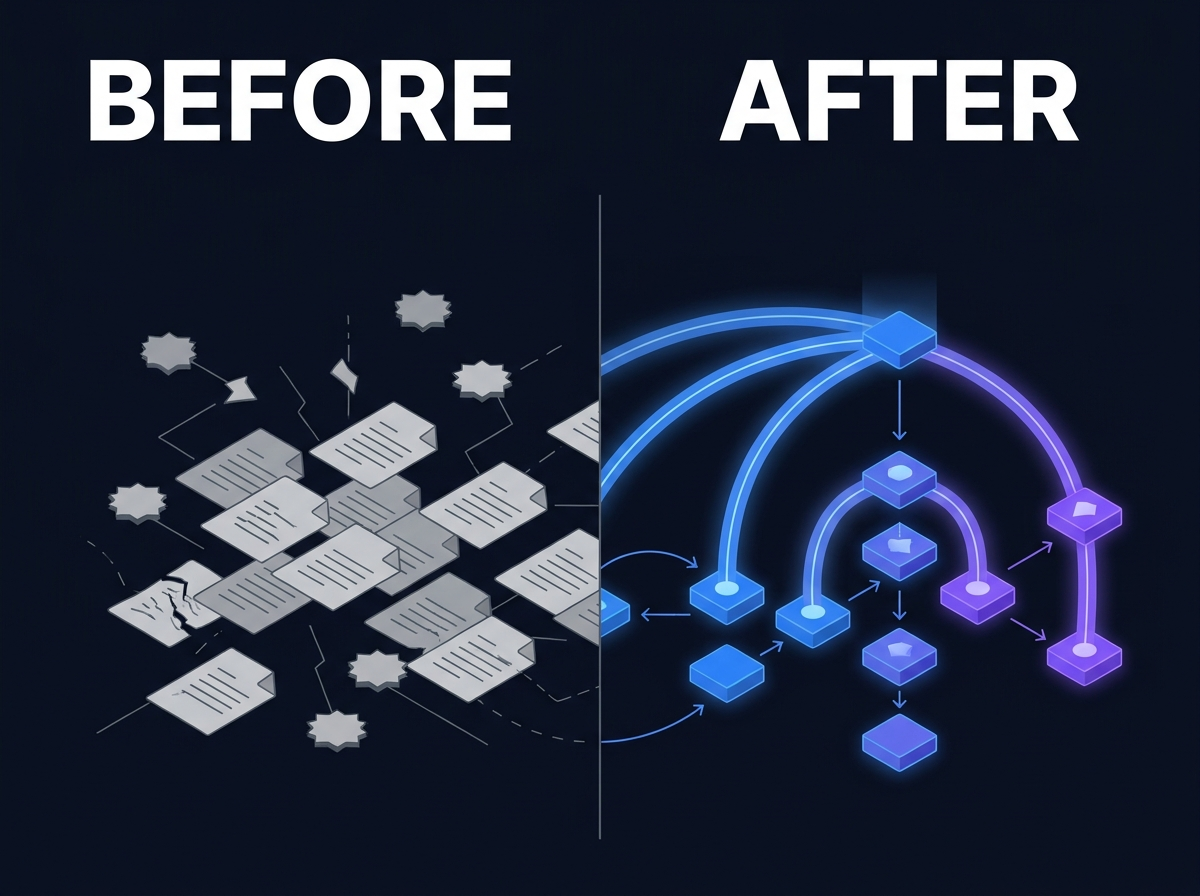
Knowledge Management is the organizational capability that structures, governs, and sustains information so it remains trustworthy, reusable, and accountable over time. It focuses on meaning, lifecycle, and ownership: taxonomy, metadata, provenance, version clarity, and curation workflows for high-value corpora. Knowledge Management is not the same as file storage, a wiki, document management alone, or Enterprise Search. Each addresses a different layer of the information stack. Effective KM programs define corpus scope, assign stewards, integrate with discovery paths, and maintain content after launch rather than treating taxonomy as a one-time project. KM without findability produces portals nobody uses. Findability without structure surfaces duplicates and obsolete versions. Mature programs integrate both. Buyers evaluating Knowledge Management should assess ownership models, metadata flexibility, lifecycle control, search integration, and AI readiness rather than portal aesthetics alone.
Executive Summary
- Knowledge Management is the organizational capability that structures, governs, and sustains information so it remains trustworthy, reusable, and accountable over time.
- It focuses on meaning, lifecycle, and ownership: taxonomy, metadata, provenance, version clarity, and curation workflows for high-value corpora.
- Knowledge Management is not the same as file storage, a wiki, document management alone, or Enterprise Search. Each addresses a different layer of the information stack.
- Effective KM programs define corpus scope, assign stewards, integrate with discovery paths, and maintain content after launch rather than treating taxonomy as a one-time project.
- KM without findability produces portals nobody uses. Findability without structure surfaces duplicates and obsolete versions. Mature programs integrate both.
- Buyers evaluating Knowledge Management should assess ownership models, metadata flexibility, lifecycle control, search integration, and AI readiness rather than portal aesthetics alone.
Category Definition
Knowledge Management (KM) is an organizational capability, supported by people, process, and technology, that transforms fragmented information into structured organizational knowledge. KM defines how content is described, related, governed, maintained, and trusted across its useful life. Where file storage answers where bytes live and Enterprise Search answers what authorized users can find across systems, Knowledge Management answers what content means, whether it is authoritative, who owns it, and how long it should remain available.
The discipline draws on decades of practice in libraries, records management, professional services knowledge sharing, and engineering configuration control. In modern enterprises, KM spans documents, media, structured records, expert-identified corpora, and curated reference sets distributed across many repositories. Technology enables KM at scale, but stewardship and policy determine whether KM produces trust or another unused portal.
Core functions
Industry practice groups Knowledge Management around several operational functions:
Taxonomy and controlled vocabulary. Shared terms, hierarchies, and faceted classifications let teams describe content consistently. Taxonomies connect documents and assets to business concepts: clients, matters, products, programs, campaigns, studies, and practice areas. Without shared language, search facets and reports fragment by department jargon.
Metadata models and entity linking. Metadata describes content beyond filename: author, approval state, effective date, related entities, sensitivity, retention class, and domain-specific attributes. Entity linking connects items to clients, projects, assemblies, or campaigns so users discover related material without manual browsing.
Provenance and version clarity. KM distinguishes draft from final, superseded from current, and copy from canonical source. Users must know which version is approved for operational use. Provenance tracks origin, modifications, and approval chain where policy requires.
Lifecycle governance. Content moves through defined stages: creation, review, publication, periodic review, supersession, archival, and disposition. Rules control visibility at each stage, trigger review dates, and align with records management where regulated content is in scope.
Curation and corpus management. Not all content merits full KM treatment. Programs define governed corpora: policy libraries, methodology sets, template collections, specification hierarchies, onboarding paths, and expert-maintained reference sets. Curation elevates high-value content into managed collections with named owners.
Stewardship and accountability. Knowledge stewards own taxonomy quality, metadata standards, and lifecycle decisions for a domain. Stewardship is a role, not a software feature. Platforms support workflows; organizations assign people.
What Knowledge Management answers
At a practical level, Knowledge Management answers questions such as:
- What is this content and why does it exist?
- Which version is authoritative for operational use?
- Who owns maintenance and review?
- How does this item relate to clients, products, or programs we care about?
- When should this content be retired or superseded?
It does not, by itself, guarantee that a user searching across fifty repositories will find an arbitrary file in a legacy share. Cross-system discovery belongs to Enterprise Search. Retention economics belong to storage infrastructure. Rights enforcement for creative production belongs to Digital Asset Management.
Relationship to adjacent categories
Knowledge Management sits in a stack of enterprise knowledge capabilities:
| Layer | Primary question |
| File storage | Where are bytes retained? |
| Digital Asset Management | How is media governed for production and rights? |
| **Knowledge Management** | **What is authoritative, structured, and owned?** |
| Enterprise Search | What can authorized users find across systems? |
| Private AI | What grounded answers can models produce from governed sources? |
KM is the structure and trust layer. It makes content understandable and accountable. Search makes content reachable. AI applies intelligence only where both structure and permissions are reliable.
Knowledge Management vs. related terms
Document management focuses on capture, versioning, and workflow within a defined repository. KM spans multiple repositories and emphasizes semantic structure, stewardship, and cross-domain taxonomy.
Wiki or intranet portal depends on manual authoring in one system. KM in modern enterprises connects existing repositories, enriches metadata in place, and governs corpora without forcing migration to a single wiki.
Records management applies retention schedules and legal holds to declared records. KM often overlaps on high-value document corpora but extends to working knowledge, templates, and media reference sets that records programs may not classify at creation.
Content services platform is a vendor category that may include document management, workflow, and search. KM is the practice and outcome; platforms are enablers. Buying a platform without stewardship design produces empty libraries.
Enterprise Search indexes and retrieves. KM explains what retrieval results mean and which results deserve trust. See Enterprise Search Is Not Knowledge Management for the operational boundary.
Understanding these distinctions helps leaders scope programs correctly. KM investments fail when organizations expect a portal to replace findability, or expect search to replace taxonomy and ownership.
Why It Matters
Organizations produce information continuously: policies, contracts, specifications, analyses, creative assets, training materials, and project deliverables. Without KM discipline, that production outpaces anyone's ability to know what is current, who maintains it, and whether reuse is safe.
The cost appears as version confusion, duplicated effort, onboarding drag, and compliance exposure. A practitioner opens three candidates for "the approved template" and picks the wrong one. An engineer references a superseded specification. A marketer republishes creative without valid rights metadata. A new hire learns from a wiki page nobody updated in four years. None of these failures require missing files. They require missing structure and ownership.
Knowledge Management matters because operational scale breaks informal knowledge transfer. When fifty people shared a hallway, tacit knowledge compensated for weak repositories. At five thousand people across regions and acquisitions, tacit transfer becomes a bottleneck. KM codifies what must be shared explicitly: canonical sources, defined terms, lifecycle rules, and named stewards.
Operational impact
Version trust. Teams stall when they cannot identify the authoritative document. KM marks approved versions, suppresses obsolete drafts from default discovery, and links superseded items to replacements.
Reuse and consistency. Methodology guides, templates, and reference analyses save time when governed corpora are maintained. Without KM, each project reinvents prior work or inherits inconsistent approaches from duplicate files.
Onboarding acceleration. New hires need curated paths: policies, role-specific playbooks, and approved examples. KM assembles those paths deliberately rather than leaving hires to guess folder names.
Regulatory and client accountability. Regulated industries and professional services firms must demonstrate which policy, disclosure, or deliverable standard applied at a point in time. KM provides provenance and lifecycle evidence storage alone cannot supply.
AI grounding quality. Private AI and retrieval-augmented generation depend on corpora where deprecated, draft, or unapproved content can be excluded. KM designates approved sources for inference. Ungoverned file dumps produce fluent wrong answers.
Strategic impact
For chief knowledge officers and KM directors, the discipline is how intellectual capital scales beyond individual experts. Experts retire, rotate, and join competitors. Governed corpora preserve methodology, decisions, and reference material the organization paid to produce.
For CIOs and enterprise architects, KM is the semantic layer that makes platform investments coherent. Connectors integrate systems. Search indexes them. KM defines which subsets carry authority signals, how metadata maps across sources, and which lifecycle events propagate to the index.
For line-of-business leaders, KM reduces rework and client risk in domains where document quality directly affects outcomes: legal work product, engineering specifications, clinical protocols, campaign compliance, and financial reporting packages.
Knowledge Management is not documentation for its own sake. It is operational infrastructure for organizations whose work product is information. Deferring KM produces short-term speed and long-term fragility.
Common Misconceptions
Knowledge Management carries decades of baggage from failed portal projects and unused taxonomies. Clear definitions prevent repeated mistakes.
Misconception 1: Knowledge Management is a wiki or SharePoint site
A site with pages is not a KM program. KM requires corpus definition, stewardship, metadata standards, lifecycle rules, and integration with how people find content daily. Empty portals and stale wikis are symptoms of missing ownership, not proof that KM failed as a category.
Misconception 2: Knowledge Management replaces Enterprise Search
KM structures high-value content. Search discovers content across the estate. A curated portal with weak enterprise search becomes a side repository practitioners bypass. Search without structure surfaces chaos faster. Mature programs need both. ART-03 explores the boundary in detail.
Misconception 3: Taxonomy design is a one-time workshop
Taxonomies evolve with products, regulations, acquisitions, and practice areas. KM requires ongoing steward review, term deprecation, and alignment with authoring workflows. One-time taxonomy projects produce binders nobody uses after reorganization.
Misconception 4: Everything must be tagged before KM delivers value
Full-estate tagging is impractical. Effective programs start with governed corpora where version confusion or compliance risk justifies investment: policies, templates, specifications, regulated records, onboarding libraries. Expand as stewards prove sustainable workflows.
Misconception 5: KM is a library science project disconnected from IT
Modern KM depends on connectors, metadata sync, search integration, identity, and audit infrastructure. IT and KM must co-own architecture. KM directors who ignore integration produce portals disconnected from daily systems. IT teams who ignore stewardship produce indexes without trust signals.
Misconception 6: AI will organize our content automatically
Machine learning assists classification and entity extraction. It does not replace corpus definition, approval workflow, or accountability for what enters AI retrieval scope. AI accelerates KM when governance rules exist. It amplifies disorder when they do not.
Misconception 7: KM success equals document count in the portal
Volume metrics reward uploading without curation. Quality metrics focus on canonical usage, metadata completeness in governed corpora, review compliance, and reduced duplicate creation in priority domains. Avoid KPIs that incentivize shelf filling.
Misconception 8: Knowledge Management means forcing all content into one system
Rip-and-replace migration is rarely required. Many programs govern content in place via connectors, enrich metadata at source systems, and designate authoritative copies without moving every legacy file. KM defines truth and structure; storage location can remain heterogeneous.
Clarifying these misconceptions aligns expectations with industry practice. KM is stewardship and structure at scale, not a portal launch event.
Practical Examples
These scenarios are composite patterns drawn from common enterprise situations. They are illustrative, not attributed to specific customers.
Professional services methodology and templates
A consulting firm maintains methodology guides, proposal templates, and deliverable examples across SharePoint, Teams, and a legacy share from an acquired practice. Engagement managers need the approved template for a regulated industry proposal.
Without KM, search returns dozens of variants. Managers copy the most recent filename and hope. With KM, a governed corpus marks templates approved by the risk committee, assigns practice-area stewards, and records review dates. Enterprise Search surfaces governed templates with authority badges and suppresses draft variants from default results. Managers start from trusted sources. Legal review cycles shorten because the starting template is already approved.
Engineering configuration and specification control
A manufacturer maintains released specifications in PLM, working notes on shares, and troubleshooting articles in a wiki. Engineers must reference released revisions for production and field service.
Knowledge Management links specifications to product entities and revision states. Superseded revisions remain auditable but do not appear as active recommendations. Change notices trigger steward review of related wiki articles. Enterprise Search indexes PLM exports with revision metadata so engineers filter by product and release state. Phone calls to senior technicians decrease when authoritative specs are both structured and findable.
Policy and compliance libraries
A financial services organization publishes policies, standards, and procedure documents subject to periodic review and regulatory examination. Employees bookmark PDFs locally. Intranet pages fall out of date.
KM defines a policy corpus with effective dates, owners, approval workflow, and supersession rules. When a policy updates, the prior version moves to archived state with clear redirect to the current document. Search boosts the active policy in results. Examiners receive provenance evidence: who approved, when effective, what changed. Storage alone held files. KM held accountable truth.
Media reference and creative reuse
A marketing organization maintains brand guidelines, approved claims language, and reusable campaign elements. Creative teams need reference material alongside DAM assets.
Digital Asset Management governs media masters, rights, and production metadata. Knowledge Management governs narrative reference: claims substantiation files, brand voice guides, and legal-approved messaging frameworks linked to campaign entities. Search connects DAM assets to KM reference documents so creatives see rights and messaging context together. Reuse accelerates without compliance surprises.
Research institutional knowledge after turnover
A research institute preserves study protocols, instrument configurations, and analysis templates across lab shares and document systems. Principal investigators retire. New programs repeat setup work.
KM assigns stewards per research domain, curates onboarding collections for standard protocols, and marks deprecated instrument configs unsafe for current equipment. Enterprise Search indexes lab notebooks and linked datasets with study identifiers. New researchers discover prior methods without relying on oral tradition alone.
Government program documentation across administrations
A public agency maintains program guidance, forms, and operational manuals used by field offices. Political transitions and reorganizations rename units and shuffle websites.
KM preserves corpus identity independent of org chart changes. Documents retain program entity links and lifecycle history. Deprecated guidance moves to archival state with pointers to replacements. Field staff search by program function, not by current division acronym. Continuity survives administrative change because structure is explicit.
Evaluation Criteria
Organizations evaluating Knowledge Management platforms and programs should assess people, process, and technology together. Software without stewardship fails. Stewardship without integration fails. The following criteria reflect industry-standard evaluation practice.
Corpus definition and ownership
| Criterion | What to verify |
| Scope boundaries | Named corpora with business sponsors, not "everything" |
| Steward roles | Assigned owners per domain with time allocated |
| Approval workflow | Draft, review, publish paths with audit trail |
| Corpus prioritization | Phased rollout plan starting with high-risk or high-reuse domains |
Taxonomy and metadata model
| Criterion | What to verify |
| Controlled vocabulary | Enterprise terms with scoped extensions for departments |
| Required vs optional fields | Templates by content type without excessive custom object sprawl |
| Entity model | Clients, products, matters, programs, campaigns linkable to content |
| Evolution | Term deprecation, merge, and split without breaking indexes |
Lifecycle and version control
| Criterion | What to verify |
| States | Draft, active, deprecated, archived, disposition |
| Supersession | Clear replacement links and visibility rules |
| Review cycles | Scheduled recertification for policies and templates |
| Retention alignment | Integration with records management and legal hold |
Authoring and contribution workflow
| Criterion | What to verify |
| Friction | Experts can contribute without bypassing governance |
| In-place enrichment | Metadata applied at source repositories where content lives |
| Bulk ingest | Migration and connector paths for existing high-value libraries |
| Quality gates | Steward review queues before broad publication |
Enterprise Search integration
| Criterion | What to verify |
| Authority signals | Curated corpora visible in unified search results |
| Metadata sync | Facets reflect KM fields at query time |
| Suppression rules | Deprecated drafts excluded from default discovery |
| Known-item tests | Users find governed items from main search experience |
Permission and ethical boundaries
| Criterion | What to verify |
| ACL inheritance | KM permissions align with source systems |
| Matter or project walls | Sensitive domains isolated where required |
| AI scope | Separate designation of corpora approved for inference |
Format and media coverage
| Criterion | What to verify |
| Document types | Office, PDF, HTML, email references |
| Media linkage | DAM assets linked with rights metadata |
| Scans and AV | OCR and transcript references where knowledge lives in non-text formats |
Operational sustainability
| Criterion | What to verify |
| Steward dashboards | Orphan content, expired reviews, broken relationships |
| Governance council | Cross-functional policy body with executive sponsor |
| Integration roadmap | Connectors maintained as source systems change |
| Success measures | Qualitative indicators tied to reuse and version trust, not upload volume |
Program readiness scorecard
Before platform scale-up, assess organizational readiness:
| Signal | Ready | Not ready |
| Named corpus owners | Yes | "IT will own it" |
| Executive sponsor | Active | Absent after kickoff |
| Search integration funded | In phase one | Deferred indefinitely |
| Pilot corpus selected | One domain with pain | Entire estate day one |
| Records alignment | Legal/records engaged | KM isolated from retention |
Procurement teams map these criteria to RFP sections. Deeper evaluation guidance appears in the warm-tier Knowledge Management Evaluation Guide (WP-06) available through the evaluation portal.
How It Relates To Other Categories
Knowledge Management is one pillar in a six-pillar enterprise knowledge model. Category definition articles establish vocabulary. Supporting articles explore failure modes, costs, and transformation paths.
Category definition peers (ART-11 to ART-15)
| ID | Article | Relationship to Knowledge Management |
| ART-11 | [What Is Digital Asset Management?](/resources/articles/what-is-digital-asset-management/) (planned) | DAM governs media operations and rights; KM governs document-centric and cross-domain corpora; both supply metadata to search |
| ART-12 | What Is Knowledge Management? | This article |
| ART-13 | [What Is Enterprise Search?](/resources/articles/what-is-enterprise-search/) | Search distributes KM-structured content; KM improves search precision and trust signals |
| ART-14 | [What Is Private AI?](/resources/articles/what-is-private-ai/) (planned) | AI retrieves from KM-governed corpora with citations and exclusion rules |
| ART-15 | [What Is Data Sovereignty?](/resources/articles/what-is-data-sovereignty/) (planned) | Deployment and audit boundaries affect where KM metadata and indexes reside |
Dark data category definition lives in What Is Dark Data and Why Most Organizations Ignore It (ART-01).
Supporting articles (ART-01 to ART-10)
| ID | Article | Relationship |
| ART-01 | [What Is Dark Data](/resources/articles/what-is-dark-data/) | Content activation and classification precede KM on legacy estates |
| ART-02 | [Private AI vs Public AI](/resources/articles/private-ai-vs-public-ai/) | Governed corpora define what AI may retrieve |
| ART-03 | [Enterprise Search Is Not Knowledge Management](/resources/articles/enterprise-search-vs-knowledge-management/) | Essential boundary for procurement and architecture |
| ART-04 | [Why DAM Projects Fail](/resources/articles/why-dam-projects-fail/) | Media governance complements KM for creative reference |
| ART-05 | [Hidden Cost of Information Sprawl](/resources/articles/hidden-cost-information-sprawl/) | Sprawl is the condition KM and search address together |
| ART-06 | [Private AI Strategy and Data Sovereignty](/resources/articles/private-ai-strategy-data-sovereignty/) | KM as prerequisite for AI strategy |
| ART-07 | [Cost of Unsearchable Information](/resources/articles/cost-of-unsearchable-information/) | Findability pain when KM exists without search integration |
| ART-08 | [AI, Privacy, and Enterprise Risk](/resources/articles/ai-privacy-enterprise-risk/) | Governance gaps when KM corpora bleed into AI scope |
| ART-09 | [More Than File Storage](/resources/articles/more-than-file-storage/) | KM as structure layer above storage |
| ART-10 | [Searchable Knowledge Capstone](/resources/articles/searchable-knowledge-from-documents-media-dark-data/) | End-to-end transformation narrative |
Live platform anchors
- [Knowledge Management feature page](/features/knowledge-management/)
- [Enterprise Search](/features/enterprise-search/)
- [Digital Asset Management](/features/digital-asset-management/)
- [Platform Integrations](/platform/integrations/)
- [Platform Overview](/platform/overview/)
- [Corporate Knowledge solution](/solutions/corporate-knowledge/)
Readers should pair this definition with ART-03 for category boundaries, ART-09 for the storage-to-KM transition, and WP-06 for evaluation depth.
Where Prodigy Fits
Prodigy delivers Knowledge Management as a distinct pillar within a unified platform, not as a generic wiki bolted onto search. The capability supports taxonomy, metadata models, entity relationships, lifecycle governance, and curated corpora across documents and connected media.
KM integrates with Enterprise Search so authority signals and governed collections appear in the discovery path practitioners already use. Digital Asset Management extends governance to creative libraries where rights and production metadata dominate. Platform Integrations connect existing repositories so teams enrich and govern content in place rather than migrating everything to a new silo.
For organizations building toward AI, Private AI retrieves from corpora that inherit KM structure and search permissions. Dark Data Intelligence helps teams classify legacy estates before elevating subsets into governed KM corpora.
Prodigy does not position KM as a standalone portal disconnected from findability, or search as a substitute for stewardship. It treats Knowledge Management as operational infrastructure for organizations that need trustworthy, reusable knowledge at scale.
For evaluation depth beyond this definition, see the Knowledge Management feature page and the warm-tier evaluation guide in the portal.
FAQ
What is knowledge management? Knowledge Management is the organizational capability that structures, governs, and sustains information so it remains trustworthy and reusable over time. It includes taxonomy, metadata, provenance, lifecycle rules, curated corpora, and stewardship.
How is knowledge management different from enterprise search? Enterprise Search helps users find content across systems. Knowledge Management defines what content means, which version is authoritative, who owns it, and how it is maintained. Search emphasizes discovery. KM emphasizes trust and structure.
Is knowledge management the same as a document management system? Not exactly. Document management focuses on repositories and workflow within defined systems. KM spans multiple repositories, emphasizes semantic structure and cross-domain taxonomy, and assigns stewardship across corpora.
Do we need a KM platform if we have SharePoint? SharePoint provides storage and collaboration. KM requires corpus definition, taxonomy standards, lifecycle discipline, and integration with enterprise discovery. SharePoint can be a source system within a broader KM program.
Can knowledge management work without migrating all content? Yes. Many programs govern content in place through connectors and metadata enrichment while designating authoritative copies for high-value corpora. Hybrid approaches are common.
Who should own knowledge management? Ownership is shared. Business stewards own domain corpora. IT provides integration and platform operations. Legal and records align retention. Executive sponsorship sustains funding beyond portal launch.
How does knowledge management relate to AI? AI retrieval quality depends on governed corpora with clear approval states and exclusion rules. KM designates which content is safe for inference and which remains human-search only.
What is a knowledge steward? A steward owns taxonomy quality, metadata standards, and lifecycle decisions for a domain such as a practice area, product line, or content type. Stewards review contributions and maintain corpus health over time.
CTA
Explore Knowledge Management on the Prodigy platform Primary: Knowledge Management
Continue your evaluation Secondary: Register for the evaluation portal
Request a demo Tertiary: Request a Demo