What Is Dark Data and Why Most Organizations Ignore It
lightbulb Executive Summary
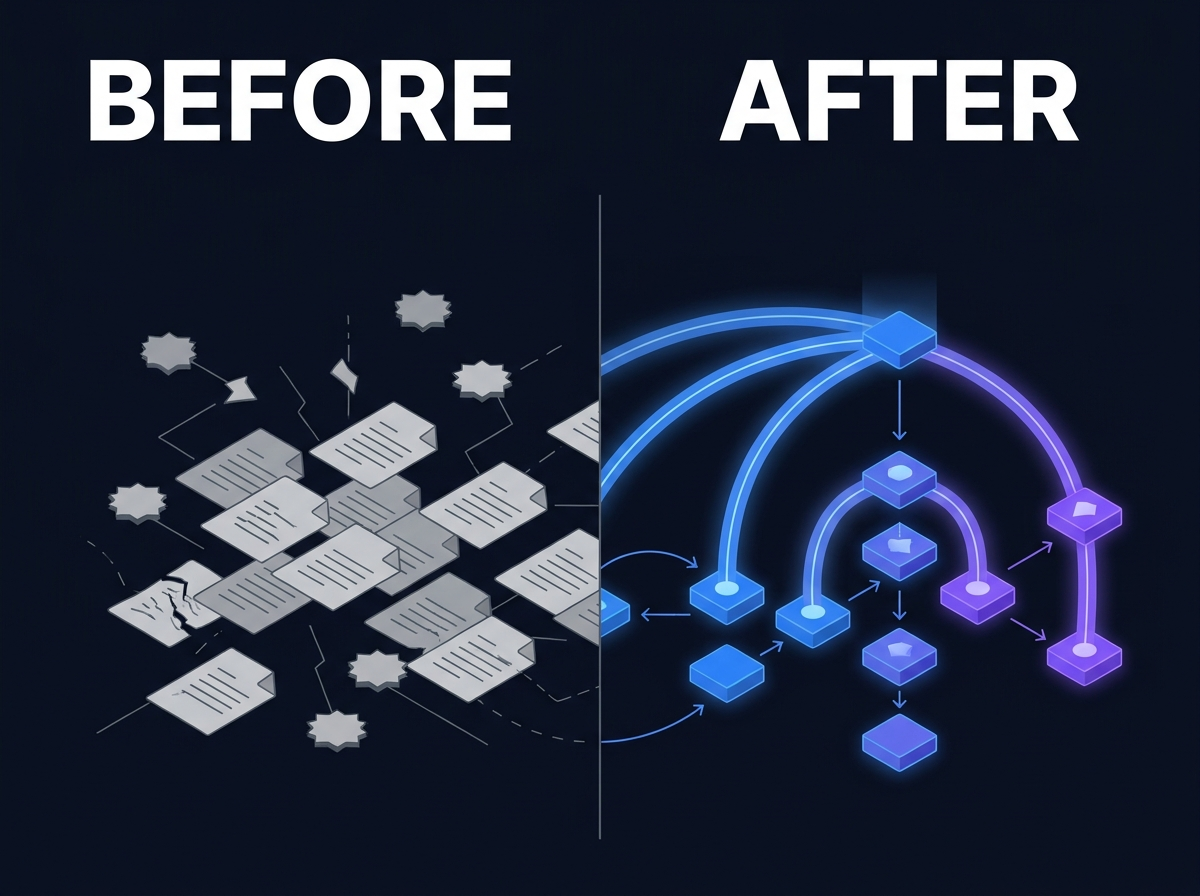
Dark data is information your organization already stores but cannot readily find, use, or govern. It is not the same as backup, cold archive, or structured records management. Those categories have owners. Dark data often has none. Most organizations ignore dark data until storage costs spike, a compliance review surfaces unknown content, or a project team recreates work that already exists somewhere in the estate. The operational cost is not abstract. It shows up as duplicated effort, slower onboarding, e-discovery exposure, and media libraries that nobody trusts. A practical program inventories content in place, classifies risk, applies governance, and activates only what has business value. Deletion is a valid outcome when retention has no purpose.
Executive Summary
- Dark data is information your organization already stores but cannot readily find, use, or govern.
- It is not the same as backup, cold archive, or structured records management. Those categories have owners. Dark data often has none.
- Most organizations ignore dark data until storage costs spike, a compliance review surfaces unknown content, or a project team recreates work that already exists somewhere in the estate.
- The operational cost is not abstract. It shows up as duplicated effort, slower onboarding, e-discovery exposure, and media libraries that nobody trusts.
- A practical program inventories content in place, classifies risk, applies governance, and activates only what has business value. Deletion is a valid outcome when retention has no purpose.
1. Introduction
Every large organization has a story about the file nobody could find.
Maybe it was a contract version buried in a shared drive from a reorg three years ago. Maybe it was b-roll footage from a campaign that marketing recreated because the original lived on a retired editor's project folder. Maybe it was a research dataset that compliance flagged during an audit because nobody knew it existed.
The information was not missing. It was stored. It was backed up. It was even duplicated across systems. It was simply unavailable to the people who needed it, invisible to search, and outside any governance process anyone could name.
That is dark data.
The term sounds technical, but the experience is familiar to anyone who has run operations, legal discovery, creative production, or research programs at scale. Dark data is the gap between what an organization possesses and what it can actually use. It accumulates quietly, year after year, because storage is easy and discovery is hard.
This article defines dark data in enterprise terms, explains why leadership teams deprioritize it, and outlines a practical approach to reducing risk without treating every old file as sacred.
2. Problem Definition
What dark data is
Dark data is enterprise information that is collected, stored, and retained, but not actively used, indexed, or governed in ways that make it accessible to authorized users.
Common forms include:
- Project folders on shared drives with no current owner
- Email PST exports and legacy mail archives
- Scanned documents without OCR or metadata
- Video and image libraries missing rights, talent releases, or descriptive tags
- Database exports and flat files from retired applications
- Duplicate copies of the same document across SharePoint sites, NAS volumes, and local backups
- Research and engineering files that outlived the team that created them
Dark data is often confused with related categories. The distinctions matter for remediation.
| Category | Definition | Typical owner |
| **Dark data** | Stored but unused and poorly governed | Often unassigned |
| **ROT data** | Redundant, obsolete, or trivial content | Records or IT |
| **Cold archive** | Intentionally retained, low-access content | Records management |
| **Backup** | Point-in-time recovery copy | Infrastructure team |
Cold archive and backup are deliberate choices. Dark data is what happens when retention has no purpose and discovery has no path.
What dark data is not
Dark data is not a data science concept about unstructured signals waiting for machine learning. In enterprise operations, it is simpler and more expensive: files your organization pays to keep but cannot put to work.
It is also not automatically waste. Some dark data has latent value. A decade of engineering drawings may contain specifications still referenced on active programs. A media archive may hold licensed assets with years of remaining usage rights. The problem is not existence. The problem is that nobody can separate valuable content from noise without a discovery process.
Why the problem grows with the organization
Dark data scales with headcount, acquisitions, system migrations, and tool sprawl. Each event adds repositories faster than teams retire them.
Mergers copy entire file estates into the surviving organization. Platform migrations leave "just in case" folders behind. Employees depart without transferring ownership of working directories. Creative and research teams adopt new tools while old libraries remain on network shares nobody monitors.
The result is an information estate that grows in volume while shrinking in navigability.
3. Why Existing Approaches Fail
Organizations do not ignore dark data because they are careless. They ignore it because the usual responses were designed for different problems.
Storage expansion treats the symptom
When capacity alerts fire, the default response is more storage, tiered archive, or cloud migration. That keeps content alive but does not make it findable. In many cases it increases sprawl by adding another location where duplicates can live.
Storage teams solve retention economics. They do not solve accessibility or governance.
Big-bang cleanup projects stall
Periodic cleanup initiatives start with ambition and end with spreadsheets. Without automated inventory, teams manually sample folders, argue about what to delete, and stop when the next quarter's priorities arrive.
Fear of deleting something important paralyzes disposition. Legal and compliance stakeholders are asked to bless removals they cannot evaluate file by file. The project pauses. The data stays dark.
Search deployed without activation
Some organizations attempt to index everything and declare the problem solved. Indexing unknown content without classification can surface material to users who should not see it. It can also produce noisy results that train people to stop trusting search.
Search makes activated content findable. It does not replace the work of deciding what should be activated, tagged, governed, or removed.
Records management scope is too narrow
Formal records programs focus on declared records with retention schedules. Dark data often lives outside those boundaries: working files, exports, creative assets, research artifacts, and operational debris that nobody classified as a record at creation.
Records management is necessary. It is not sufficient for the full unused estate.
No executive owner
Dark data sits between IT, legal, records, knowledge management, and line-of-business leadership. When everyone is peripherally responsible, no one is accountable. Budget follows visible pain: outage prevention, license renewals, active project delivery. Dark data pain is diffuse until it becomes acute.
4. Practical Examples
These scenarios are composite patterns drawn from common enterprise situations. They are not attributed to specific customers.
The post-merger shared drive
Two companies combine. IT copies the acquired company's file shares into a "Legacy Acquired Co" tree on the network. Project managers are told the material is available if needed. No taxonomy is applied. No owners are named.
Eighteen months later, a product liability question requires engineering specifications from the acquired portfolio. The team searches the current PLM system and finds nothing. Someone remembers the legacy folder exists. Hours turn into weeks as engineers manually browse directories with inconsistent naming conventions. A specification is found, but nobody can confirm it is the final approved version.
The data was never lost. It was dark.
The media library without metadata
A marketing organization maintains thousands of video clips and still images across a DAM, agency deliveries, and production server paths. Campaign teams upload new assets every week. Older material lacks talent releases, usage rights, and descriptive tags.
A regional team needs localized creative for a recurring seasonal campaign. They cannot find approved assets from prior years. They commission new shoots. Legal later questions whether the recreated assets infringe on talent agreements from older files nobody could locate.
The cost was not storage. The cost was rework and exposure created by ungoverned reuse.
The research archive after team turnover
A research group stores experiment notes, instrument outputs, and image datasets on a lab share. Principal investigators retire or move to other divisions. Graduate students depart. The share remains mapped, but active staff no longer know what folders contain.
A new program needs baseline comparisons to prior studies. The team cannot determine which datasets are complete, which instruments produced them, or whether consent and privacy constraints allow reuse. They rerun experiments that may have already been conducted.
Scientific value did not disappear. Access and context did.
The compliance discovery surprise
During litigation or regulatory inquiry, an organization must produce documents matching custodians and date ranges. Counsel assumes core systems cover the request. e-Discovery expands to email, shares, and local archives.
Previously unknown PST files, contractor laptops imaged late, and cloud sync folders surface content counsel did not expect. Review cost rises. Negotiation posture weakens when the organization cannot demonstrate consistent governance.
Dark data becomes visible at the worst possible moment.
5. Business Impact
Dark data rarely appears as a single line item on a budget. Its costs distribute across operations, risk, and opportunity.
Operational drag
Teams spend time asking colleagues, browsing folders, and recreating work because prior art is not discoverable. Senior staff become human search engines. Onboarding stretches as new hires learn unofficial paths to content that should be indexed.
Duplication and inconsistency
When canonical versions are unknown, teams produce parallel documents, designs, and datasets. Downstream decisions diverge because participants worked from different sources of truth.
Storage and backup overhead
Unused data still consumes primary storage, backup windows, replication bandwidth, and cloud egress. The expense is justified when content is governed and retrievable. It is harder to defend when nobody can name the business purpose of retention.
Compliance and legal exposure
Unknown content is unknown risk. Retention without policy invites challenges during discovery. Privacy obligations apply to data whether or not anyone uses it. Talent rights, export controls, and contractual confidentiality can all attach to files sitting outside managed systems.
Lost reuse value
Media, research, engineering, and professional services organizations invest heavily in content that could be reused if findable. Dark data locks that investment away. Teams fund new work when existing material would suffice.
None of these impacts require invented statistics to be credible. They are visible in everyday workflows the moment you ask teams how they find last year's deliverable.
6. Recommended Approach
Dark data remediation is a program, not a project. It works best when scoped to reduce risk and activate value without requiring a full estate migration on day one.
Step 1: Inventory in place
Start with automated discovery across file shares, collaboration platforms, email archives, DAM systems, and selected application exports. The goal is a corpus map: where content lives, how much exists, who has access, and what formats are represented.
Avoid boiling the ocean. Prioritize repositories tied to compliance scope, high-value reuse, or known pain.
Step 2: Classify by risk and value
Apply classification frameworks that legal, records, and business owners can understand. Categories might include regulated personal data, client confidential material, export-controlled technical data, licensed media, active program files, and candidates for disposition.
Classification drives what gets activated, what gets restricted, and what gets deleted.
Step 3: Govern before you amplify
Apply retention rules, access controls, and ownership assignment before expanding search to sensitive corpora. Permission-aware discovery is non-negotiable in enterprise environments.
Metadata enrichment, OCR for scans, and transcription for video make content searchable without moving it to a new silo.
Step 4: Activate selectively
Activation means connecting classified content to Enterprise Search and, where appropriate, Knowledge Management workflows so authorized users can find and trust it.
Not everything deserves activation. Some material should remain archived with tight access. Some should be destroyed when retention expires.
Step 5: Assign ongoing ownership
Dark data returns if nobody maintains taxonomy, retention, and ingest standards. Name business owners for major repositories. Integrate governance into project closeout, M&A playbooks, and employee offboarding.
Step 6: Measure progress qualitatively
Track outcomes that matter: fewer rediscovered duplicates, faster onboarding paths, reduced discovery surprises, improved media reuse, and clearer disposition decisions. Avoid vanity metrics that reward indexing volume without governance quality.
7. Where Prodigy Fits
Prodigy addresses dark data as an intelligence problem, not a storage problem. The platform connects to existing repositories, inventories and classifies content in place, and applies governance before expanding discovery.
Dark Data Intelligence supports discovery across documents, media, and operational file estates. Teams can identify unknown content, enrich it with metadata and format processing, and decide what to activate, restrict, or retire without a rip-and-replace migration.
Activated content flows into Enterprise Search with permissions intact, so search results respect the same access boundaries as source systems. Structured corpora can be managed through Knowledge Management when business value depends on taxonomy, entity relationships, and lifecycle control.
For organizations that later apply AI to governed content, Private AI runs on infrastructure the customer controls. That matters when dark data remediation surfaces material that should never leave the organizational boundary.
Prodigy does not ask enterprises to delete their archives blindly or move everything to a new drive. It asks them to see what they have, govern what they keep, and make valuable content searchable to the people allowed to use it.
8. Conclusion
Dark data is not a fringe IT curiosity. It is the normal byproduct of decades of digital work without consistent discovery and governance.
Organizations ignore it because the pain is distributed, ownership is unclear, and storage is cheap until it is not. They pay later in duplicated work, compliance surprises, and archives that teams stop trusting.
The way forward is disciplined and incremental: inventory, classify, govern, activate, and disposition. Some files will become searchable knowledge. Others will prove that retention without purpose is risk without benefit.
The question for leadership is not whether dark data exists. It does. The question is whether you will discover it on your schedule or on someone else's.
9. CTA
Explore how Prodigy addresses dark data Primary: Dark Data Intelligence
Continue your evaluation Secondary: Register for the evaluation portal
Request a demo Tertiary: Request a Demo
FAQ
What is dark data? Dark data is enterprise information that is stored but not actively used, indexed, or governed in ways that make it accessible to authorized users. It includes orphaned project files, unsearchable scans, legacy exports, and media without metadata.
Is dark data the same as big data? No. Big data refers to large, often high-velocity datasets used for analytics. Dark data refers to unused or inaccessible content in everyday enterprise repositories such as file shares, email archives, and media libraries.
Is all dark data worthless? No. Some dark data has significant reuse value. The challenge is separating valuable content from redundant or risky material without manual folder browsing.
Who should own dark data remediation? Ownership is shared. IT provides discovery tooling and infrastructure. Legal and records define retention and risk categories. Business units name content owners. Knowledge management often coordinates taxonomy and activation.
Can dark data be searched safely? Yes, when search is permission-aware and preceded by classification. Indexing everything without governance can expose sensitive content to unauthorized users and create false confidence in result quality.
Related Reading
| Title | Type | Path |
| Private AI vs Public AI: What Organizations Need to Know | Article (Wave 1) | `/resources/articles/private-ai-vs-public-ai/` |
| Enterprise Search Is Not Knowledge Management | Article (Wave 1) | `/resources/articles/enterprise-search-vs-knowledge-management/` |
| Platform Overview | Platform page | `/platform/overview/` |
| Knowledge Management for Professional Services | Solution page | `/solutions/corporate-knowledge/` |