
Knowledge Management for Professional Services
Consulting firms, advisory practices, and knowledge-intensive enterprises depend on prior engagements, methodologies, templates, and expert judgment distributed across email, slides, document stores, and collaboration tools. Client delivery teams recreate work because prior artifacts are hard to find. Onboarding stretches when new hires cannot access governed playbooks quickly. Practice leaders lack visibility into what content exists versus what teams still rebuild. Client confidentiality and competitive segments require strict access boundaries between practices.

Why Traditional Approaches Fail
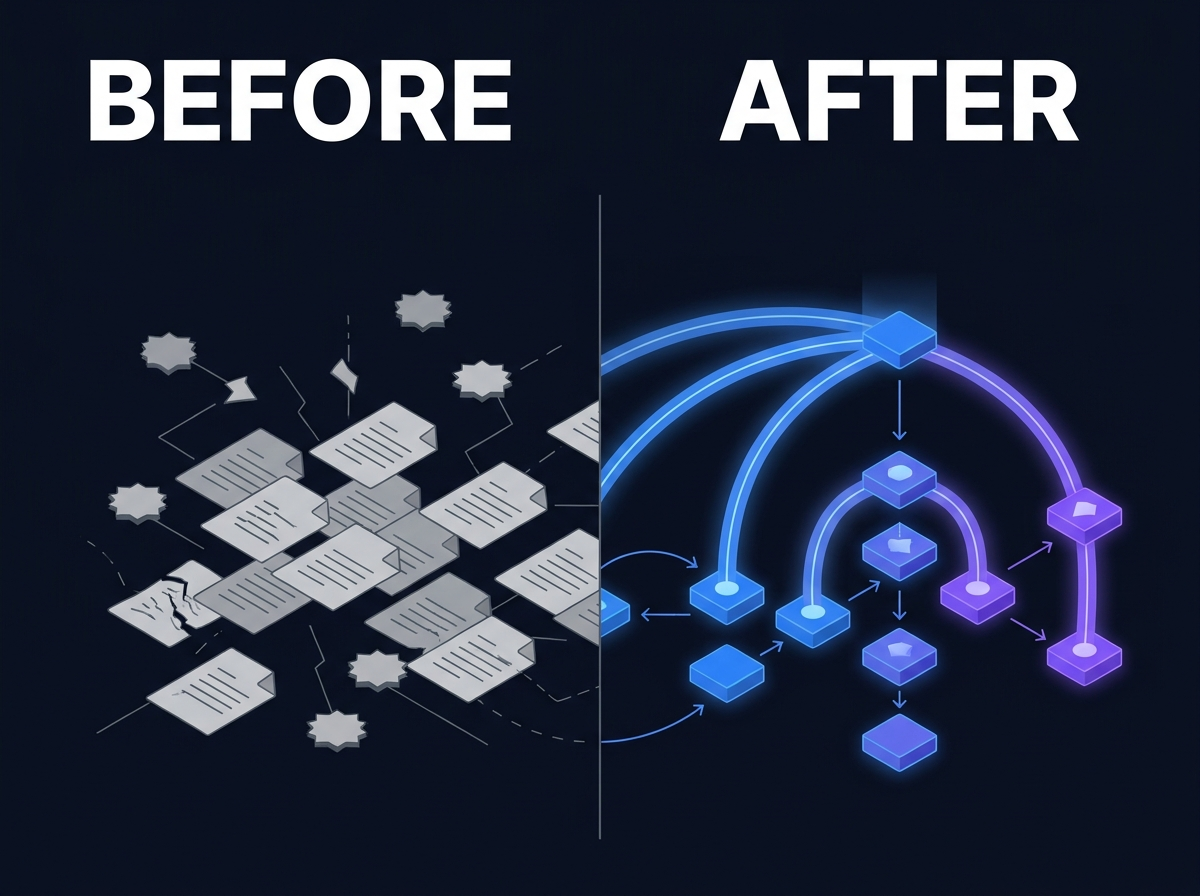
SharePoint and shared drives become unstructured archives without consistent taxonomy. Traditional KM portals suffer from poor adoption when search and update workflows are manual. Enterprise search without practice-aware permissions risks exposing the wrong engagement materials. Separate AI pilots use public tools that violate client data handling rules. Dark data accumulates in legacy folders with no disposition path. Point solutions for search, DAM, and AI do not share governance or permissions.
Prodigy structures corporate knowledge with metadata, entity linking, and Data Governance on infrastructure the firm controls. Enterprise Search connects silos with permission-aware results. Knowledge Management links people, clients, engagements, and artifacts. Private AI supports delivery and research on governed corpora only. Dark Data Intelligence helps KM teams inventory redundant and unused content. One platform supports search, structure, and controlled AI without exporting client material to public services.
Explore Knowledge Management
Relevant Capabilities
Knowledge Management
Structure playbooks, engagement artifacts, and practice taxonomies.
Read more →Enterprise Search
Find templates, prior deliverables, and experts across systems.
Read more →Private AI
Q&A and synthesis on governed internal content.
Read more →Dark Data Intelligence
Identify duplicate and unused files during KM programs.
Read more →Digital Asset Management
Govern decks, media, and brand assets used in client work.
Read more →Security & Sovereignty
Data Sovereignty for client-confidential material.
Read more →Encryption & Security
Access control, audit, and encryption for firm IP.
Read more →Platform Overview
Full platform map for evaluation committees.
Read more →Security & Governance Considerations
Client confidentiality and competitive separation are core requirements. Prodigy enforces role- and engagement-based access in search and Private AI. Audit logs support risk and compliance review. Deployment on firm-controlled infrastructure satisfies most client security questionnaires. Customer data does not train external models. Chinese walls and practice boundaries can be reflected in index scope and retrieval policy.

Practice boundaries
Chinese walls reflected in search and access policy.
Client confidentiality
Processing on firm-controlled infrastructure.
Audit for risk review
Log access, search, and inference activity.
Example Use Cases

Engagement startup
Delivery teams retrieve methodology guides, redacted prior work, and templates for a new client under practice permissions.
Practice onboarding
New hires access governed playbooks and exemplar deliverables without weeks of shadowing.

Proposal and pursuit support
Pursuit teams search qualified case material and subject matter content with rights and confidentiality intact.

KM rationalization
Knowledge teams run dark data analysis to archive or remove redundant content from shared repositories.
Who this solution is for
Managing partners
Protect firm IP and improve delivery efficiency.
COOs
Scale knowledge reuse across practices.
Practice leaders
Equip teams with findable prior work.
Chief knowledge officers
Run taxonomy, governance, and adoption programs.
L&D directors
Connect onboarding to governed playbooks.
IT and security leaders
Approve platforms that meet client data rules.
Expected Business Outcomes
Delivery teams reduce time spent searching for prior work and approved templates. Onboarding becomes more self-serve with governed access to playbooks. Practice leaders see improved reuse of qualified content. Risk teams gain a controlled path for Private AI instead of unmanaged public tools. KM programs make progress on archive cleanup with inventory visibility.

Evaluate Knowledge Management for your practice model
Request a demo to review search, Knowledge Management, and access boundaries for your highest-value practice area.
Request a Demo