What Is Enterprise Search?
lightbulb Executive Summary
Enterprise Search is the capability that lets authorized users query across multiple repositories and receive relevant results with source permissions intact. It focuses on discovery at read time: finding documents, media, records, and exports wherever they live, not moving them to a single drive. Enterprise Search is not the same as desktop search, native SharePoint search, a wiki, or a knowledge management program. Each solves a different layer of the information problem. Effective programs require connector breadth, permission-aware indexing, format coverage (OCR, transcription, metadata), and relevance tuning tied to real corpora. Search quality depends on underlying metadata and governance. Search surfaces what exists; it does not by itself create trustworthy canonical versions. Buyers evaluating Enterprise Search should assess technical depth, security model, and integration with Knowledge Management and Private AI rather than demo flashiness alone.
Executive Summary
- Enterprise Search is the capability that lets authorized users query across multiple repositories and receive relevant results with source permissions intact.
- It focuses on discovery at read time: finding documents, media, records, and exports wherever they live, not moving them to a single drive.
- Enterprise Search is not the same as desktop search, native SharePoint search, a wiki, or a knowledge management program. Each solves a different layer of the information problem.
- Effective programs require connector breadth, permission-aware indexing, format coverage (OCR, transcription, metadata), and relevance tuning tied to real corpora.
- Search quality depends on underlying metadata and governance. Search surfaces what exists; it does not by itself create trustworthy canonical versions.
- Buyers evaluating Enterprise Search should assess technical depth, security model, and integration with Knowledge Management and Private AI rather than demo flashiness alone.
Category Definition
Enterprise Search is an organizational capability, supported by software, that enables authorized users to find information across multiple content repositories through a unified query experience. The search layer indexes or federates content from file shares, collaboration platforms, email archives, digital asset libraries, line-of-business exports, and other connected systems. Results respect access controls from source systems so users see only what they are permitted to access at query time.
The category emerged because enterprise content outgrew single-application search. A team member working in Microsoft 365 may need a specification stored in PLM, a contract attachment in email, a policy on a legacy share, and licensed media in a DAM. Native search within each application helps only when the user already knows which system holds the answer and how that system names content. Enterprise Search addresses cross-system discovery: one query path across the estate.
Core functions
Industry practice groups Enterprise Search around several operational functions:
Unified indexing and connectors. Content from disparate systems is ingested or queried through connectors that keep the search index synchronized as files change, permissions shift, and new repositories come online. Connector quality determines whether search reflects current reality or a stale snapshot.
Query and relevance. Users submit natural language or keyword queries through a search interface. The system ranks results using textual match, metadata signals, recency, business rules, and optional behavioral signals where policy permits. Facets and filters let users narrow by source, type, date, entity, or custom metadata.
Permission-aware results. Enterprise environments require that search never expose content beyond what the requesting user could access in the source system. Permission-aware search evaluates access control lists, group membership, matter boundaries, ethical walls, and sensitivity labels at query time, not only at index time.
Format and enrichment coverage. Search must handle more than Word documents and PDFs. Scanned images require optical character recognition. Video and audio require transcription or time-coded metadata. Email containers, CAD exports, and compressed archives need parsing pipelines. Metadata extraction and entity recognition improve findability when filenames alone carry no meaning.
Administration and tuning. Operators configure connectors, inclusion rules, ranking boosts, promoted results, and audit logging. Query logs support relevance tuning and compliance review without treating search as a set-and-forget appliance.
What Enterprise Search answers
At a practical level, Enterprise Search answers questions such as:
- Where is the document, media file, or record I am allowed to see?
- Which results across systems best match my query?
- How do I open or preview the item without knowing which application stores it?
It does not, by itself, answer whether a found document is the authoritative version, who owns its lifecycle, or whether usage rights permit republication. Those questions belong to Knowledge Management, Digital Asset Management, and records governance.
Relationship to adjacent categories
Enterprise Search sits in a stack of enterprise knowledge capabilities:
| Layer | Primary question |
| File storage | Where are bytes retained? |
| Digital Asset Management | How is media governed for production and rights? |
| Knowledge Management | What is authoritative, structured, and owned? |
| **Enterprise Search** | **What can authorized users find across systems?** |
| Private AI | What grounded answers can models produce from governed sources? |
Search is the discovery layer. It makes existing content reachable. It does not replace structure, rights workflow, or archive disposition programs.
Enterprise Search vs. related terms
Desktop or OS search indexes files on a local machine or synced folder. It does not cross enterprise repositories or enforce centralized permission policy.
Native application search (SharePoint, Google Drive, Confluence) excels within one ecosystem. It rarely covers the full heterogeneous estate without additional integration.
Federated search queries multiple systems at request time without maintaining a unified index. Latency and permission consistency vary. Many enterprise platforms combine unified indexing with selective federation for systems that cannot be fully indexed.
Enterprise search appliances historically referred to hardware or software bundles focused on indexing. Modern platforms often deliver search as a cloud or customer-controlled service with connector ecosystems rather than a single box.
AI chat and copilots are application layers that may use search for retrieval. They are not substitutes for permission-aware indexing, format coverage, and connector discipline.
Understanding these boundaries helps procurement teams write requirements that match the problem. Buyers who need cross-system findability should evaluate Enterprise Search. Buyers who need taxonomy, lifecycle, and canonical corpora need Knowledge Management as well.
Why It Matters
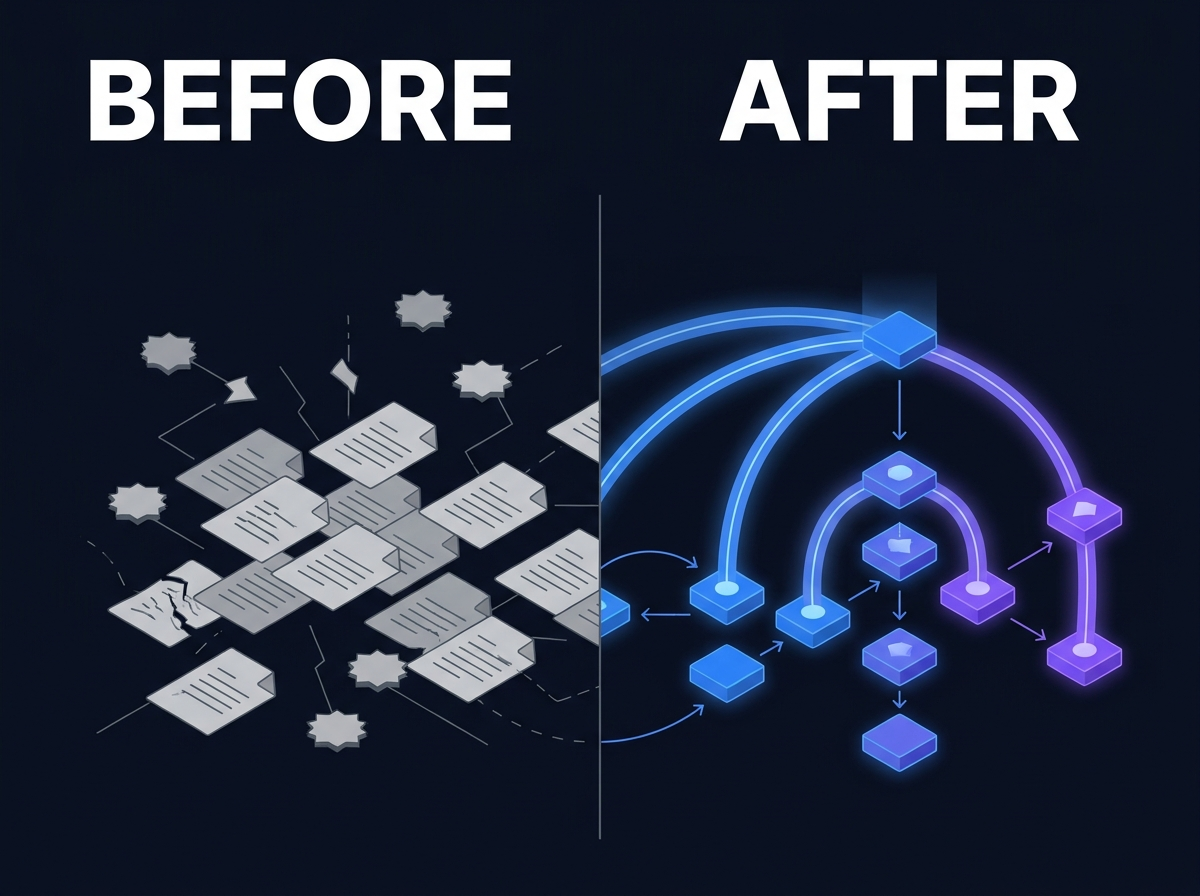
Organizations accumulate content faster than any single team can track. Mergers add legacy shares. Platform migrations leave parallel libraries. Project teams create folders with names meaningful only to participants. Email attachments duplicate files already stored elsewhere. The information exists. The path to it does not.
When discovery fails, work slows in ways that rarely appear on a storage invoice. Practitioners open three applications, run overlapping queries, and interrupt colleagues who become informal indexes. Senior staff forward links and validate versions because junior staff cannot trust search results. Onboarding stretches as new hires learn folklore about which drive, which site, and which person to ask.
Enterprise Search matters because it converts possession into accessibility for authorized users. It reduces the tax of fragmented repositories without requiring every team to migrate content to a new silo on day one. Connectors index or query in place while source systems remain systems of record.
Operational impact
Time and interruption. Search friction is interrupt-driven. Every failed query sends a user to chat, email, or a hallway conversation. Multiplied across thousands of employees, the calendar cost concentrates on people whose time is most expensive.
Duplication and rework. When teams cannot find prior deliverables, they recreate documents, re-edit media, and re-run analyses. Duplication wastes labor and introduces inconsistency when parallel versions diverge.
Decision delay. Executives and project teams defer decisions waiting for context that already exists somewhere in the estate. The delay is not missing data. It is unreachable data.
Compliance and audit friction. Regulators and internal audit ask for proof of policies, communications, or technical records. Teams assemble responses manually when no unified discovery path spans repositories under scope.
AI readiness. Organizations adopting Private AI or retrieval-augmented generation depend on search infrastructure that respects permissions and covers formats in production corpora. Ungoverned retrieval amplifies the wrong documents faster than manual search ever could. Enterprise Search is the technical foundation for grounded AI, not an optional convenience.
Strategic impact
For CIOs and enterprise architects, Enterprise Search is how platform investments connect. Knowledge Management structures high-value corpora. DAM operationalizes media. Dark data programs activate archives. None of those investments deliver daily value if users still cannot find content across systems.
For knowledge management directors, search is how structure reaches practitioners where they work. A curated portal with weak enterprise-wide findability becomes a side repository. Search is the distribution mechanism for governed knowledge.
For security and legal stakeholders, permission-aware search is non-negotiable. Indexing without ACL synchronization creates access incidents. Query-time enforcement and audit logging align discovery with confidentiality obligations.
Enterprise Search is not a luxury feature for large enterprises. It is the minimum viable discovery layer once content spans more than a handful of repositories and formats. Organizations that defer it pay in daily friction until a compliance event, AI initiative, or leadership mandate forces the conversation.
Common Misconceptions
Category confusion drives failed procurement and unrealistic expectations. These misconceptions appear repeatedly in enterprise evaluations.
Misconception 1: Enterprise Search is just a better search box in SharePoint
Native collaboration search solves findability within one platform. Enterprise Search addresses cross-system discovery with consistent governance, enrichment pipelines, and connector strategy. Replacing SharePoint search inside SharePoint is a different project than indexing SharePoint, NAS, DAM, email archives, and PLM exports behind one experience.
Misconception 2: Enterprise Search replaces Knowledge Management
Search finds content. Knowledge Management structures, governs, and sustains authoritative corpora over time. Deploying search across chaotic file shares often surfaces duplicates and obsolete drafts, which leadership misreads as search failure. Search worked. The underlying disorder became visible. Both capabilities are necessary. Neither substitutes for the other. See Enterprise Search Is Not Knowledge Management for the full distinction.
Misconception 3: Index everything first, govern later
Bulk indexing without classification and permission review can expose sensitive content and produce noisy results that train users to distrust search. Governance before amplification is standard practice in regulated environments. Inclusion rules, sensitivity labels, and connector scoping matter as much as index size.
Misconception 4: Search projects succeed or fail on relevance algorithms alone
Ranking algorithms matter. They cannot compensate for missing OCR on scans, absent transcripts on video, stale ACLs, or filenames with no semantic signal. Format coverage and metadata enrichment are part of Enterprise Search scope, not optional add-ons for later phases.
Misconception 5: Federated search is always simpler than unified indexing
Federation avoids maintaining a central index but introduces latency, inconsistent permission behavior, and limited enrichment at query time. Many enterprises use hybrid models: unified index for high-volume sources, federation for specialized or low-latency-tolerant systems. The architecture choice depends on volume, network boundaries, and compliance requirements.
Misconception 6: Enterprise Search is a one-time deployment
Content changes continuously. Connectors drift. New repositories appear after every acquisition and tool rollout. Search requires ongoing connector health monitoring, relevance tuning from query logs, and coordination with KM and records programs. Treating search as a project with a fixed end date guarantees regression.
Misconception 7: AI chat makes Enterprise Search obsolete
Generative AI interfaces depend on retrieval from corpora. Without permission-aware search, format processing, and connector discipline, AI produces fluent answers from the wrong sources. AI is an application layer on search and governance, not a replacement for indexing infrastructure.
Misconception 8: Employees will adopt search if IT deploys it
Adoption follows result quality. If first queries return junk, users revert to asking people. Successful programs pilot with known-item tests on real corpora, tune relevance with domain stewards, and promote curated corpora where KM defines authoritative content.
Clarifying these misconceptions early saves budget and prevents the pattern where an organization buys search expecting KM outcomes, or deploys AI expecting search outcomes, and blames the vendor when the architecture was category-confused from the start.
Practical Examples
These scenarios are composite patterns drawn from common enterprise situations. They are illustrative, not attributed to specific customers.
Engineering specifications across PLM, shares, and wikis
A manufacturing organization stores released specifications in PLM, test reports on engineering shares, and troubleshooting notes in a wiki. A technician searches for torque specifications on an assembly that shipped three years ago.
Native PLM search finds the current revision for active programs but poorly indexes legacy product lines migrated before a system upgrade. The share returns PDF exports with identical filenames from different revision cycles. The wiki page was edited by an intern and never approved.
Enterprise Search with connectors to PLM exports, shared drives, and the wiki, plus metadata tying results to product entities, lets the technician filter by assembly number and revision state. Permission-aware results hide export-controlled attachments the technician is not cleared to view. KM practices that mark superseded specifications reduce confusion between draft exports and released records.
Without Enterprise Search, the technician calls a senior engineer. With search but without permissions and metadata, the technician might find an obsolete or restricted document. With search and governance together, the technician reaches an authorized, relevant result in one query path.
Professional services methodology discovery
A consulting firm maintains methodology decks, proposal templates, and deliverable examples across SharePoint, Teams, and a legacy file share from an acquired practice. Consultants search for a digital transformation proposal template before a client deadline.
Results include twelve versions with ambiguous titles, duplicates from the acquired firm, and draft decks never approved for client use. Enterprise Search returns all indexed files matching keywords. The firm lacks a governed corpus that marks which templates are current and approved for which practice area.
Knowledge Management defines the canonical template set, ownership, and review cycle. Enterprise Search makes those templates discoverable alongside other permitted content and can boost curated corpora in ranking. Neither capability alone closes the workflow gap. Together they reduce deadline-driven reinvention of existing materials.
Legal matter files and ethical walls
A law firm indexes matter files, research memos, and client communications. Associates search for prior analysis on a regulatory question relevant to a new matter.
Results must respect ethical walls between matters and client groups. An associate on Matter A must not see work product indexed from Matter B even if keywords match. Enterprise Search evaluates wall rules at query time in addition to file ACLs. Results include draft and final memos unless KM or records policy suppresses drafts from general discovery.
An associate who cites a draft in client communication creates quality and liability exposure. Search permissions prevent unauthorized access. KM and matter management practices label authoritative work product. AI retrieval, if deployed later, inherits the same boundaries.
Media and campaign asset rediscovery
A marketing organization stores hero imagery and campaign video across a DAM, agency FTP deliveries, and production server paths. Creatives search for licensed assets from a prior campaign season for reuse in a regional variant.
Search returns duplicates with incomplete rights metadata. Creatives recreate assets. Legal later questions usage rights on rediscovered files. Digital Asset Management governs media-specific metadata and rights. Enterprise Search extends discovery across DAM and adjacent repositories so creatives encounter rights fields before reuse. OCR and transcript coverage matter when briefs and scripts live in PDF and video formats rather than structured DAM records.
Public sector records across agencies and legacy archives
A government department must respond to a records request spanning email archives, document management systems, and scanned paper files from a legacy digitization project. Staff search across indexed collections with classification labels applied during a dark data activation program.
Scanned files without OCR never surface in keyword search. Enterprise Search with OCR pipelines and retention metadata lets staff query across formats while excluding collections under separate legal hold. Audit logs document who searched what for accountability. Permission boundaries reflect clearance levels rather than only folder ACLs.
Research datasets and lab notebooks after team turnover
A research institute stores experiment notes, instrument outputs, and image datasets on lab shares. Principal investigators retire. New staff search for baseline data from prior studies.
Filenames reference instruments and dates nobody current recognizes. Enterprise Search with entity extraction, linked metadata to study identifiers, and transcript search on lab video logs helps staff discover relevant datasets. Knowledge Management assigns stewardship for active corpora and marks deprecated datasets that should not appear in default result sets.
Evaluation Criteria
Organizations evaluating Enterprise Search should assess capabilities against estate-specific requirements, not generic demo scripts. The following criteria reflect industry-standard evaluation practice for enterprise discovery platforms.
Connector breadth and synchronization
| Criterion | What to verify |
| Source coverage | Connectors exist for priority systems: collaboration, file shares, email, DAM, PLM, CRM exports, ticket attachments |
| Sync model | Live, scheduled, or event-driven updates; acceptable latency defined per source |
| Scope controls | Inclusion and exclusion rules at site, path, mailbox, or collection level |
| Connector health | Monitoring, error handling, and reprocessing for failed batches |
Permission-aware results
| Criterion | What to verify |
| ACL synchronization | Index reflects source permissions; reconciliation cadence documented |
| Query-time enforcement | Access checked when user runs query, not only at index time |
| Special boundaries | Ethical walls, matter isolation, clearance levels, sensitivity labels |
| Audit | Query and result access logging configurable for compliance |
Format and enrichment coverage
| Criterion | What to verify |
| Office and PDF | Full-text extraction on standard document types |
| OCR | Search inside scanned PDFs and image-only files |
| Video and audio | Transcription search and time-coded retrieval where required |
| Container parsing, attachment indexing, thread context | |
| Metadata | Facets on DAM and KM fields, custom attributes, extracted entities |
Relevance and user experience
| Criterion | What to verify |
| Known-item retrieval | Pilot users find specific documents they already know exist |
| Ranking controls | Boost rules, promoted results, curated corpus elevation |
| Facets and filters | Source, type, date, entity, taxonomy filters match user mental models |
| Query analytics | Logs exportable for tuning and governance review |
Security and deployment
| Criterion | What to verify |
| Data residency | Index location, processing boundaries, customer-controlled deployment options |
| Encryption | In transit and at rest; customer-managed keys where required |
| Network architecture | On-premises connectors, VPC deployment, air-gap support if needed |
| Identity integration | SSO, group membership sync, service account policy |
Governance and KM integration
| Criterion | What to verify |
| Curated corpora | KM authority signals visible in results |
| Lifecycle metadata | Draft vs final, deprecated content suppression options |
| Records alignment | Hold and retention awareness where configured |
| AI readiness | Retrieval APIs with permission inheritance for Private AI |
Operational sustainability
| Criterion | What to verify |
| Administration | Role-based admin, connector management without vendor for every change |
| Scale | Sizing guidance for volume, format mix, and query load |
| Support model | SLAs for connector failures and security patches |
| Total cost | Licensing, connector fees, enrichment compute, and staffing for tuning |
Pilot design
Effective evaluations run a structured pilot before enterprise rollout:
1. Select three to five high-pain repositories with named business sponsors. 2. Define known-item tests: documents users must find by title, entity, and keyword. 3. Test with real accounts at different permission levels. 4. Measure format gaps: scans, video, and email in scope or explicitly deferred. 5. Document what search surfaces that reveals governance debt versus platform failure.
Procurement teams can map these criteria to RFP sections. Deeper buyer guidance appears in the warm-tier Enterprise Search Buyer Guide (WP-03) available through the evaluation portal.
How It Relates To Other Categories
Enterprise Search is one pillar in a six-pillar enterprise knowledge model. Category definition articles establish shared vocabulary across pillars. Problem-diagnosis and comparison articles explore where programs fail and how capabilities combine in practice.
Category definition peers (ART-11 to ART-15)
| ID | Article | Relationship to Enterprise Search |
| ART-11 | [What Is Digital Asset Management?](/resources/articles/what-is-digital-asset-management/) (planned) | DAM governs media metadata and rights; Enterprise Search extends discovery across DAM and adjacent repositories |
| ART-12 | [What Is Knowledge Management?](/resources/articles/what-is-knowledge-management/) | KM structures authoritative corpora; Enterprise Search distributes findability; ranking improves when KM supplies metadata and authority signals |
| ART-13 | What Is Enterprise Search? | This article |
| ART-14 | [What Is Private AI?](/resources/articles/what-is-private-ai/) (planned) | Private AI retrieves from governed indexes; permission-aware search is a prerequisite for safe inference |
| ART-15 | [What Is Data Sovereignty?](/resources/articles/what-is-data-sovereignty/) (planned) | Deployment boundaries and audit requirements shape where indexes run and how query logs are retained |
Dark data category definition lives in What Is Dark Data and Why Most Organizations Ignore It (ART-01).
Supporting articles (ART-01 to ART-10)
| ID | Article | Relationship |
| ART-01 | [What Is Dark Data](/resources/articles/what-is-dark-data/) | Content must be activated and classified before search can make it safely discoverable |
| ART-02 | [Private AI vs Public AI](/resources/articles/private-ai-vs-public-ai/) | Retrieval boundaries for AI depend on search permissions and corpus scope |
| ART-03 | [Enterprise Search Is Not Knowledge Management](/resources/articles/enterprise-search-vs-knowledge-management/) | Essential boundary article for procurement and architecture |
| ART-04 | [Why DAM Projects Fail](/resources/articles/why-dam-projects-fail/) | DAM and search must be scoped together for media operations |
| ART-05 | [Hidden Cost of Information Sprawl](/resources/articles/hidden-cost-information-sprawl/) | Sprawl is the environmental condition search must navigate |
| ART-06 | [Private AI Strategy and Data Sovereignty](/resources/articles/private-ai-strategy-data-sovereignty/) | Search and KM precede AI rollout in strategy frameworks |
| ART-07 | [Cost of Unsearchable Information](/resources/articles/cost-of-unsearchable-information/) | Operational pain when discovery fails; natural follow-on from this definition |
| ART-08 | [AI, Privacy, and Enterprise Risk](/resources/articles/ai-privacy-enterprise-risk/) | Access and audit risk when search permissions are weak |
| ART-09 | [More Than File Storage](/resources/articles/more-than-file-storage/) | Enterprise Search as the discovery layer above storage |
| ART-10 | [Searchable Knowledge Capstone](/resources/articles/searchable-knowledge-from-documents-media-dark-data/) | End-to-end transformation narrative connecting all pillars |
Live platform anchors
- [Enterprise Search feature page](/features/enterprise-search/)
- [Knowledge Management](/features/knowledge-management/)
- [OCR and Transcription](/features/ocr-transcription/)
- [Video Intelligence](/features/video-intelligence/)
- [Platform Integrations](/platform/integrations/)
- [Platform Overview](/platform/overview/)
Readers evaluating architecture should start with category definitions, read ART-03 for boundary clarity, then proceed to ART-07 for operational impact and WP-03 for procurement depth.
Where Prodigy Fits
Prodigy delivers Enterprise Search as a governed discovery layer across documents, media, and connected repositories. The platform indexes content in place where possible, respects source permissions at query time, and applies enrichment such as OCR and transcription so scans and AV media participate in the same search experience as native documents.
Search connects to Knowledge Management when organizations need authority signals, curated corpora, and lifecycle metadata to appear in results. Digital Asset Management extends the same model to creative libraries where rights and production metadata matter. Dark Data Intelligence addresses repositories that were never activated for search. Private AI retrieves from corpora that inherit search permissions rather than from unmanaged uploads.
Platform Integrations connect existing systems so teams improve findability without mandatory big-bang migration. Prodigy is not positioned as a search appliance that ignores governance, or as a KM portal with a basic search bar. It treats Enterprise Search as one distinct pillar within a unified platform for organizations that need cross-system discovery with permissions intact.
For evaluation depth beyond this definition, see the Enterprise Search feature page and the warm-tier buyer guide in the portal.
FAQ
What is enterprise search? Enterprise Search is the capability that lets authorized users query across multiple content repositories and receive relevant results with source permissions intact. It provides unified discovery across file shares, collaboration platforms, email, DAM, and other connected systems.
How is enterprise search different from desktop search? Desktop search indexes files on a local device or synced folder. Enterprise Search spans organizational repositories, enforces centralized permission policy, and supports connector ecosystems, enrichment pipelines, and enterprise audit requirements.
Does enterprise search replace SharePoint or Google Drive? No. Enterprise Search integrates with those systems as sources. Content often remains in native storage while the search layer provides cross-system discovery.
Can enterprise search find content inside scanned PDFs and video? Yes, when the platform includes OCR for scans and transcription for video or audio. Format coverage should be explicit in evaluation requirements. Native text extraction alone leaves large portions of many estates invisible.
Why do enterprise search projects fail? Common causes include weak metadata, chaotic source repositories, permission sync gaps, missing format pipelines, and unrealistic expectations that search alone creates governance. Search often surfaces underlying disorder correctly, which leadership misreads as product failure.
What is permission-aware search? Permission-aware search evaluates user access rights at query time so results include only content the user is authorized to see, mirroring or exceeding source system access controls.
Do we need knowledge management if we have enterprise search? In most enterprises, yes. Search finds content. Knowledge Management defines authoritative versions, taxonomy, ownership, and lifecycle. Programs that need both often fail when only one is funded.
How does enterprise search relate to AI? Private AI and retrieval-augmented generation depend on governed, permission-aware retrieval. Enterprise Search provides the indexing and access foundation AI applications use to cite sources users are allowed to see.
CTA
Explore Enterprise Search on the Prodigy platform Primary: Enterprise Search
Continue your evaluation Secondary: Register for the evaluation portal
Request a demo Tertiary: Request a Demo