The Hidden Cost of Information Sprawl
lightbulb Executive Summary
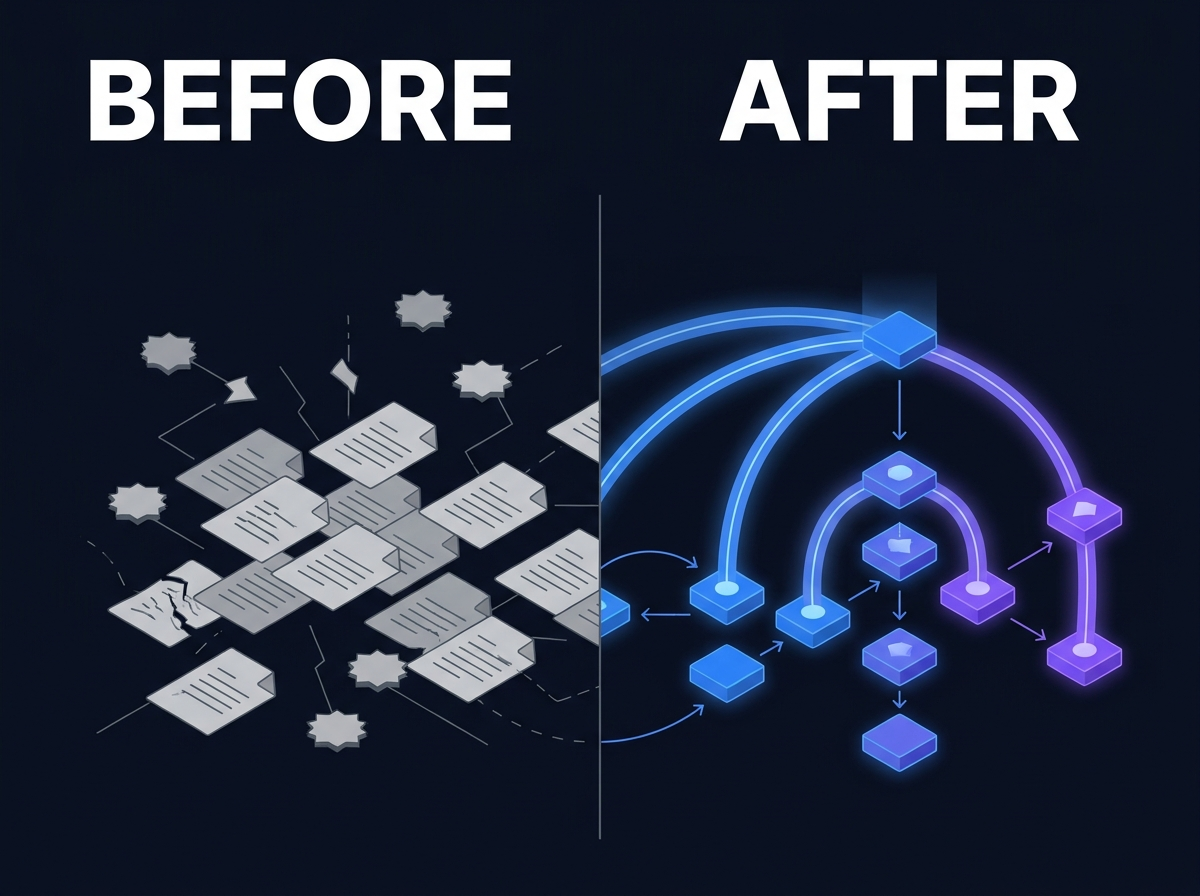
Information sprawl is an accessibility problem. Content exists across systems faster than teams can find, govern, or trust it. Costs appear as duplicated work, slower decisions, onboarding drag, and version confusion, not as a single line item. Adding storage or another repository usually increases sprawl. It does not fix findability. Search alone cannot fix missing structure. Governance alone cannot fix poor discovery. Both are required. Reducing sprawl without big-bang migration means connecting sources, governing in place, and unifying discovery with permissions intact.
Executive Summary
- Information sprawl is an accessibility problem. Content exists across systems faster than teams can find, govern, or trust it.
- Costs appear as duplicated work, slower decisions, onboarding drag, and version confusion, not as a single line item.
- Adding storage or another repository usually increases sprawl. It does not fix findability.
- Search alone cannot fix missing structure. Governance alone cannot fix poor discovery. Both are required.
- Reducing sprawl without big-bang migration means connecting sources, governing in place, and unifying discovery with permissions intact.
1. Introduction
Your organization did not lose the document. It is in four places at once.
One version sits in a SharePoint library from a reorg two years ago. Another is attached to an email thread. A third lives on a shared drive the project team still calls "temporary." A fourth was exported into a ticket system as a PDF nobody has opened since.
Everyone has a story like this. The file is not missing. It is sprawl.
Information sprawl is what happens when content volume and system count grow faster than taxonomy, ownership, and discovery can keep pace. Teams experience it as friction: long searches, repeated questions, recreated work, and decisions made on incomplete context.
Leadership often misdiagnoses sprawl as a storage problem or a training problem. It is neither. It is an architecture and governance problem that accumulates quietly until a major project, audit, or leadership change forces a reckoning.
This article names what sprawl looks like, why it accelerates in growing organizations, what it costs in everyday operations, and what actually reduces it without a risky rip-and-replace migration.
2. Problem Definition
What information sprawl is
Information sprawl is the uncontrolled spread of content across repositories, applications, and informal channels without clear ownership, canonical versions, or reliable discovery paths.
Sprawl is not the same as intentional distribution. Publishing a policy to an intranet and emailing a summary is deliberate. Sprawl is when fifteen variants of the same policy live in places nobody maintains.
Common sprawl patterns include:
- Duplicate folder trees on shared drives after every reorg
- The same deliverable in email, Teams, SharePoint, and a project tool
- Media in DAM, production servers, and agency folders with no authoritative link
- Engineering specs in PLM, wiki exports, and engineer laptops
- Research data on lab shares with no current owner
- Chat threads becoming the only place context exists
Sprawl vs. silos
Silos are isolated systems that do not connect. Sprawl is overlapping, duplicated, and inconsistently governed content across systems that may or may not connect.
An organization can have few silos and still have severe sprawl if the same content replicates everywhere without control.
Why sprawl is an accessibility problem
The core issue is not that information is absent. It is that authorized users cannot find the right version quickly enough to trust it.
When findability fails, people build personal caches: local folders, bookmarks, spreadsheets of links, and informal ask-a-colleague networks. Personal caches solve today's task and worsen tomorrow's sprawl.
3. Why Existing Approaches Fail
Adding storage or another repository
When teams cannot find content, a common response is another place to put it: a new SharePoint site, a new shared drive, a new wiki, a new DAM.
The new repository inherits content from old ones without retiring them. Sprawl doubles. The organization now searches N+1 systems instead of N.
Mandating "one system of record" without migration discipline
Leadership declares a single system of record. Teams nod. Old repositories remain open because projects still reference them, integrations were never built, or nobody has time to validate what should move.
The declared system becomes one more place content lives alongside the old places.
Search appliance without governance
Enterprise search can unify discovery, but indexing chaotic estates without classification surfaces noise. Users see duplicate versions, obsolete folders, and filenames that made sense to one team three years ago.
Search without Knowledge Management structure often confirms that sprawl is the problem without solving it.
Knowledge portal without enterprise discovery
Some organizations build curated knowledge portals with good taxonomy and editorial workflow. Practitioners still search email and drives because the portal is not where work happens and its search does not span the full estate.
The portal becomes a well-organized side repository in a sprawl ecosystem.
Cleanup campaigns without ongoing ownership
Annual cleanup initiatives delete obvious junk and stall on ambiguous folders. Without assigned owners and lifecycle rules, sprawl returns within quarters.
Cleanup is a event. Governance is a program.
Blaming user behavior
Training users to "save things correctly" fails when systems, incentives, and workflows reward speed over structure. People do what deadlines require. If the fast path bypasses governance, governance loses.
4. Practical Examples
These scenarios reflect common enterprise patterns. They are illustrative composites, not named customer stories.
The proposal template problem
A professional services firm maintains proposal templates across SharePoint, Teams, and a legacy file share from an acquired company. Consultants search all three.
Search returns twelve versions with similar titles. Some are pre-approval drafts. Some are outdated rate cards. A consultant ships a proposal with last year's terms because it was the first file that looked right.
Sprawl turned a template retrieval task into a client risk event.
The engineering spec across systems
A manufacturer stores torque specifications in PLM, test reports on a shared drive, and maintenance notes in a wiki. A field technician needs the approved spec for an assembly.
PLM has the authoritative record but poor search for technicians without PLM seats. The wiki has a summary edited two years ago. The shared drive has three PDF exports with different revision notes.
The technician calls a senior engineer. Sprawl converted search into interruption.
The campaign asset in four libraries
Marketing stores creative in a DAM, active work on a production server, agency deliveries in a cloud folder, and "approved finals" in a marketing ops SharePoint library.
A regional team launching a recurring seasonal campaign needs last year's approved hero image. Each library returns candidates. Rights metadata is incomplete in two of four sources.
The team commissions new creative. Sprawl created cost and delay, not missing files.
The project context in chat
A product launch spans Jira, Confluence, email, and Slack. Decisions happen in threads. The wiki page was never updated. The "final" brief in SharePoint predates a scope change discussed only in chat.
A new PM joins and reads the brief. They build a plan on obsolete assumptions. Sprawl hid the current truth in channels nobody indexed.
5. Business Impact
Sprawl costs distribute across operations. They rarely appear as a dedicated budget line.
Time lost to search and interruption
Knowledge workers spend significant time looking for information or waiting for colleagues to send it. Senior staff become human search engines. Calendar time shifts from judgment work to retrieval work.
Duplicated work product
When canonical versions are unknown, teams recreate analyses, designs, proposals, and datasets that already exist somewhere in the estate. Duplication wastes labor and introduces inconsistency.
Slower onboarding
New hires inherit sprawl as folklore: which drive, which site, which person to ask. Onboarding stretches from weeks to months. Productivity lag is structural, not a training gap.
Decision delay and inconsistency
Executives and project teams make decisions on partial context because assembling the full picture takes too long. Different teams act on different versions of the same truth.
Governance failures without malice
Sprawl makes lifecycle rules impossible to enforce. Retention policies cannot apply when nobody knows which copy is authoritative. Disposition stalls because every folder might matter to someone.
Platform and license accumulation
Each new repository adds storage, backup, search connectors, and license cost. Sprawl multiplies systems. IT spends on tools that overlap without reducing findability.
Eroded trust in search and repositories
When search returns junk, users stop searching. When portals feel stale, users stop contributing. Distrust is sticky and expensive to reverse.
None of these impacts require invented statistics to be credible. Ask any team where the latest approved version lives and watch the room hesitate.
6. Recommended Approach
Reducing sprawl is a program, not a weekend cleanup. Effective programs connect discovery to governance without mandatory big-bang migration on day one.
Step 1: Map the estate honestly
Inventory major repositories: file shares, collaboration platforms, DAM, PLM, CRM exports, ticket attachments, and high-volume email archives. Note owners, access models, and known pain.
You cannot govern what you have not mapped.
Step 2: Identify canonical domains
Not all content deserves equal structure. Pick domains where version confusion creates real pain: policies, templates, specifications, approved media, client deliverables, regulatory records.
Assign owners and lifecycle rules there first.
Step 3: Connect sources for discovery
Use connectors to index in place where possible. Enterprise Search should respect source permissions so discovery does not create access risk.
Users need one search experience even when content stays in native systems.
Step 4: Apply structure where it reduces chaos
Use Knowledge Management for taxonomy, metadata, entity relationships, and approval states on high-value corpora. Structure is targeted, not universal on day one.
Step 5: Govern ingest and project closeout
Sprawl accelerates when projects end without archiving rules: what moves, what stays, what expires, who owns it. Closeout checklists beat annual cleanup campaigns.
Step 6: Retire repositories deliberately
When a new system of record wins, set a retirement date for the old one. Migrate what matters. Freeze what does not. Delete what has no purpose.
Without retirement, sprawl persists by design.
Step 7: Measure findability, not file count
Track whether teams can find known items faster, whether duplicate document creation drops, and whether onboarding paths stabilize. File count is a vanity metric if search satisfaction is low.
Step 8: Prepare for AI on governed corpora
Sprawl becomes more dangerous when AI retrieval automates what manual search only assisted. Ungoverned estates produce fluent wrong answers. Fix sprawl before you amplify it with Private AI.
7. Where Prodigy Fits
Prodigy addresses sprawl by improving accessibility without forcing a single new repository to replace everything else.
Platform Overview describes the unified layer: connect existing systems, govern content in place, structure high-value corpora, and deliver permission-aware discovery across documents and media.
Enterprise Search spans repositories with ACL-aware results. Knowledge Management adds taxonomy, metadata, and lifecycle control where structure matters. Dark Data Intelligence helps teams identify unused and unknown content that contributes to sprawl without value.
Platform Integrations connect file shares, collaboration platforms, DAM, and application exports so discovery improves without mandatory migration.
For sprawl-heavy environments, solution paths such as Corporate Knowledge and Engineering map operational patterns to platform capabilities without treating every industry as identical.
Prodigy does not promise that one tool deletes sprawl overnight. It connects, governs, and makes existing information findable to the people allowed to use it.
8. Conclusion
Information sprawl is the normal byproduct of growth, acquisitions, tool adoption, and speed-first workflows. It is not a sign that teams are careless. It is a sign that discovery and governance did not scale with content.
Storage expansion, portal projects, and search appliances each fail when treated as substitutes for ownership, lifecycle rules, and unified findability.
The constructive path is honest inventory, targeted structure, connected discovery, and deliberate repository retirement. Sprawl reduces when organizations make the right version easier to find than the workaround.
If your teams spend more time hunting for information than using it, sprawl is already on the balance sheet. It is just booked under payroll and rework instead of a line anyone monitors.
9. CTA
Explore how Prodigy reduces sprawl through unified discovery Primary: Platform Overview
Continue your evaluation Secondary: Register for the evaluation portal
Request a demo Tertiary: Request a Demo
FAQ
What is information sprawl? Information sprawl is the spread of duplicate, overlapping, and poorly governed content across systems and informal channels, making it hard to find and trust the right version.
Is sprawl the same as data silos? No. Silos are isolated systems. Sprawl is duplicated and inconsistent content that may exist across many connected or disconnected systems.
Does more storage reduce sprawl? No. Additional repositories usually increase sprawl unless old systems are retired and governance is applied at ingest and project closeout.
Can enterprise search alone fix sprawl? Search improves discovery but does not replace taxonomy, ownership, and lifecycle rules. Without structure, search surfaces sprawl faster.
Who owns sprawl reduction? Ownership is shared. IT provides connectors and infrastructure. Knowledge management leads structure. Business units own repositories. Leadership enforces retirement and closeout standards.
Related Reading
| Title | Type | Path |
| What Is Dark Data and Why Most Organizations Ignore It | Article (Wave 1) | `/resources/articles/what-is-dark-data/` |
| Enterprise Search Is Not Knowledge Management | Article (Wave 1) | `/resources/articles/enterprise-search-vs-knowledge-management/` |
| Why Digital Asset Management Projects Fail | Article (Wave 2) | `/resources/articles/why-dam-projects-fail/` |
| Corporate Knowledge | Solution page | `/solutions/corporate-knowledge/` |